
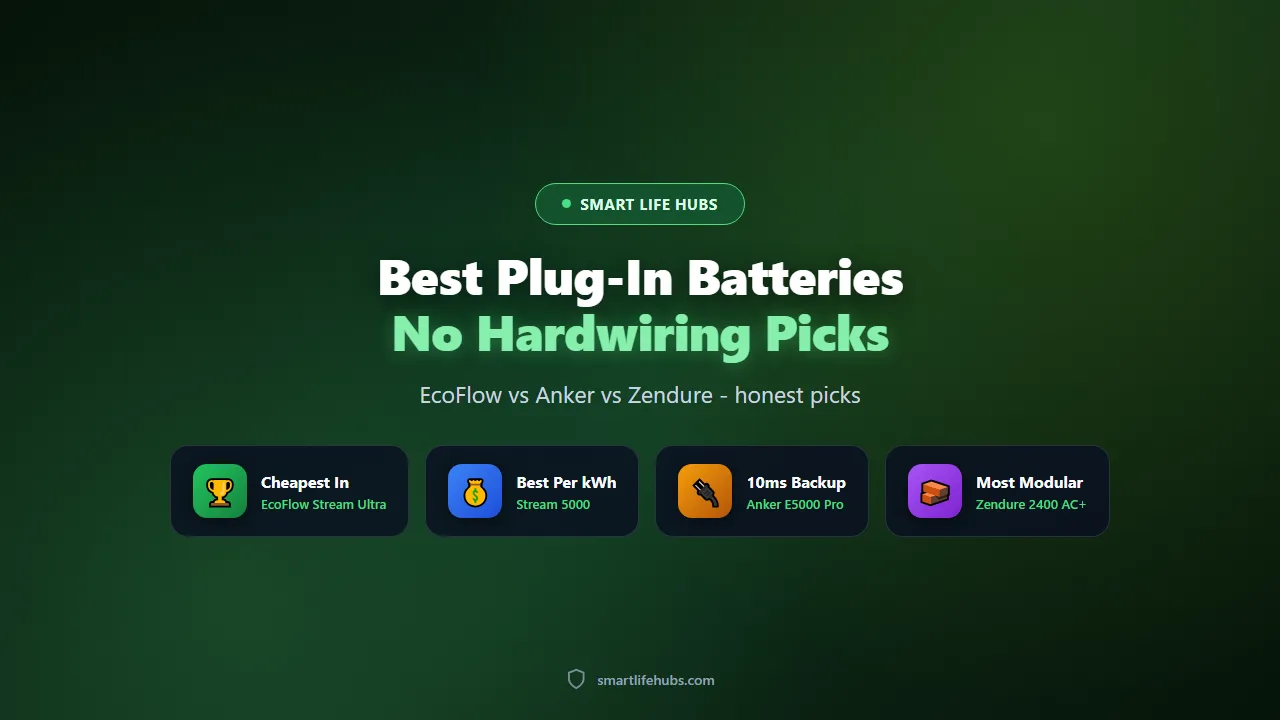
Best plug-in home batteries of 2026 are the middle ground between a portable power station and a wired whole-home system: a battery that sits on a balcony or a utility room floor, charges from solar or a normal socket, and feeds power back into your house wiring without a major installation. I have tested two of these over the past year and followed the category closely, and the honest finding is that the value per kilowatt-hour has improved dramatically, while the category’s name is misleading, because almost none of them actually plug into a socket.
That last point matters, so let me be plain about it. A “plug-in home battery” in the current market usually means an AC-coupled unit that connects to your household wiring through a dedicated circuit, an electrician and often a notification to your network operator. The genuine socket-plug-in class is the smaller balcony category, capped at around 800W of export, and it is the only one you can install yourself. If a listing promises a whole-home battery that simply plugs into a wall outlet, read the installation requirements before you believe it.
Prices below are UK and EU retail captured in November 2026, where this category is most mature. Treat them as starting points, because the price moves with capacity, solar input and whether the panels are included.
At a glance
| Product | Best for | Key specs | Price |
|---|---|---|---|
| EcoFlow Stream Ultra | Cheapest way in | 1.92kWh LFP, 2,000W solar on 4 MPPTs, 23.1 kg | About 699 GBP |
| EcoFlow Stream 5000 | Best value per kWh | 5.024kWh, 5,000W solar input, AC-coupled | About 1,599 GBP |
| Anker SOLIX Solarbank 4 E5000 Pro | Best all-in-one | 5.024kWh, 5,000W solar input, 10ms backup | About 1,599 GBP |
| Zendure SolarFlow 2400 AC+ | Best modular | 2.4kWh, expandable to 16.8kWh, AC-coupled | About 668 EUR |
| Jackery SolarVault 3 Pro Max AC | Best for existing panels | AC-coupled storage for a system you already own | About 649 EUR |
The best plug-in home batteries of 2026
1. EcoFlow Stream Ultra, cheapest way in
The Stream Ultra is the cheapest sensible entry point and the one that most buyers should price first. It stores 1.92kWh of LiFePO4, takes up to 2,000W of solar across four MPPT channels, outputs 800W to the house wiring or 2,300W through its own sockets, and weighs 23.1 kilograms. It is IP65, fanless and under 30 decibels, carries a 10-year warranty and a 6,000 cycle rating, and costs about 699 GBP direct, which works out at roughly 364 GBP per kilowatt-hour. For a household that wants to cover an evening of lights, a fridge, a television and a router, that is enough, and the app is the best in the category.
Pros
- About 699 GBP, the cheapest complete battery kit here
- 1.92kWh with four MPPTs and a 10-year warranty
- 23.1 kg, manageable on a balcony wall or floor
Cons
- Runs out early in a busy household
- Expands to 11.52kWh, half the ceiling of the bigger EcoFlow
Check today’s price on Amazon.
2. EcoFlow Stream 5000, best value per kilowatt-hour
The Stream 5000 is the pick for a bigger array and a bigger tank. It stores 5.024kWh, takes up to 5,000W of solar input, and is AC-coupled, so it is designed to add storage to a balcony system that already has a microinverter rather than replacing it. At about 1,599 GBP it works out at roughly 318 GBP per kilowatt-hour, which is the best value per unit of storage in this roundup alongside the Anker, and the 5,000W input suits a roof or a large terrace array. If you already own panels and a microinverter, this is the sensible upgrade.
Pros
- 5.024kWh at about 318 GBP per kilowatt-hour
- 5,000W solar input for a large array
- AC-coupled, so it works with an existing microinverter
Cons
- No built-in inverter, so you need one already
- Requires an electrician for the AC connection
Check today’s price on Amazon.
3. Anker SOLIX Solarbank 4 E5000 Pro, best all-in-one
The Solarbank 4 E5000 Pro is the alternative to the EcoFlow with one meaningful advantage: a 10 millisecond backup switchover, which makes it a genuine UPS for a router, a computer or a medical device rather than a battery with a multi-second gap. It stores 5.024kWh, takes 5,000W of solar input, and costs about 1,599 GBP, which is the same value per kilowatt-hour as the Stream 5000. If you want a battery that can double as an uninterruptible supply for your essential electronics, this is the one to shortlist.
Pros
- 5.024kWh and a 10 millisecond backup switchover
- 5,000W solar input, matching the EcoFlow
- About 1,599 GBP, same value per kWh as the Stream 5000
Cons
- Requires an electrician for the AC connection
- Ecosystem is less established for balcony installs in some markets
Check today’s price on Amazon.
4. Zendure SolarFlow 2400 AC+, best modular
The SolarFlow 2400 AC+ is the modular route. It is an AC-coupled battery of 2.4kWh that expands to 16.8kWh, at about 668 EUR, which makes it the cheapest way to start and the most expandable if you want to grow over several years. Zendure’s SolarFlow architecture sits between your panels and your existing microinverter, so it works with a system you already own rather than forcing a brand change. The trade-offs are a more complex setup, a heavier box and a less polished app than EcoFlow’s.
Pros
- About 668 EUR for 2.4kWh, expandable to 16.8kWh
- Works with an existing microinverter and panels
- Modular, so you can grow the storage over time
Cons
- More components and a more complicated install
- App and monitoring are less refined than EcoFlow’s
Check today’s price on Amazon.
5. Jackery SolarVault 3 Pro Max AC, best for existing panels
The SolarVault 3 Pro Max AC is the pick if you already have a solar array and just want storage from a brand you may already own. It is an AC-coupled unit priced at about 649 EUR, designed to add a battery to a system that already has a microinverter, and it keeps the panels and the inverter you have rather than making you replace them. The honest caveat is that Jackery’s home-storage line is newer than EcoFlow’s and Anker’s, so the long-term app support and the installer network are less proven.
Pros
- About 649 EUR for AC-coupled storage
- Works with panels and an inverter you already own
- Familiar brand for anyone who owns Jackery panels
Cons
- Newer home-storage line with less proven support
- Fewer published specifications than the EcoFlow and Anker units
Check today’s price on Amazon.
How to choose the best plug-in home battery
Start by checking the installation rules where you live, because the term “plug-in” is used loosely and the reality varies. A true socket-plug-in balcony unit is capped at about 800W of export and can be self-installed, sometimes with a simple registration. An AC-coupled home battery needs a dedicated circuit and usually an electrician. Read the installation section of the product page before you compare prices, or you will compare a self-install unit with a professional one and wonder why the prices differ.
Then calculate the value per kilowatt-hour, because the headline capacity is a poor guide. Divide the price by the usable capacity and compare the result across models, and remember to add the cost of any microinverter, brackets and installation. In late 2026 the better units in the UK market were working out at roughly 318 to 390 GBP per kilowatt-hour, and a unit that looks twenty percent cheaper on capacity may be more expensive on this measure.
Decide whether you need the backup speed. A battery that switches over in 10 milliseconds will keep a computer and a modem alive, while a unit with a 3-second switchover will not. For most homes the slower switchover is fine for lights and refrigeration, but if you work from home or run a medical device, the faster unit is worth the money. Check the switchover figure in the specifications rather than assuming.
Check the expansion path, because storage is the kind of purchase you may want to grow. Some units are sealed at their native capacity, some accept add-on batteries, and some scale by adding complete units in parallel. The EcoFlow and Zendure routes are genuinely modular, while an all-in-one unit with a fixed battery is simpler but less flexible.
Finally, be honest about the savings. A plug-in battery shifts daylight into the evening, and on a time-of-use tariff it can charge cheap and discharge expensive. Published estimates suggest a compact battery can save somewhere in the range of 135 to 540 dollars a year depending on the tariff and the household, which is real money but not a quick payback. A detailed UK comparison at balconysolarguide.co.uk/reviews/best-plug-in-solar-battery-uk works through the cost per kilowatt-hour of the current models if you want the numbers.
Living with a plug-in home battery
Get the positioning right before the installer arrives. A battery that feeds the house wiring needs a dry, ventilated spot within reach of a dedicated circuit, and a balcony unit needs a wall or floor that can take the weight. Check your lease if you rent, because drilling and a permanent circuit may need permission, and a battery that cannot be registered is a battery you cannot legally run.
Set the schedule to your tariff rather than the factory default. The whole point of storage is to charge when power is cheap and discharge when it is expensive, so tell the app your tariff, set the charge window, and set a reserve so the battery does not run flat before the morning. Getting this right is worth more than the difference between two batteries of similar capacity.
Watch the first month before you judge it. The app will show production, consumption and export, and the first fortnight is best spent learning your own baseline. Look for the circuits that use the most, and consider whether a small change, like shifting a dishwasher or a washing machine into the solar window, beats buying a bigger battery.
Keep the vents clear and the firmware current. These units are largely passive and reliable, but a battery wedged against a wall with no clearance runs hotter and ages faster, and a unit that never gets a firmware update misses efficiency improvements. A monthly glance at the app and an annual check of the casing is enough.
Do not expect the battery to run the heavy loads. A 2 to 5kWh unit will cover lights, refrigeration, networking, a television and a laptop, and it will struggle with an oven, a kettle, an electric shower or an air conditioner. If you want those covered, you are in the whole-home battery class, and our review of the Anker SOLIX E10 covers that step up. For the panels that feed a plug-in battery, see the best balcony solar plants.
Frequently asked questions
Frequently Asked Questions
6Do plug-in home batteries really plug into a socket?
Only the smaller balcony class does, and it is capped at about 800W of export. Most units marketed as plug-in home batteries are AC-coupled and need a dedicated circuit and usually an electrician. Read the installation requirements rather than trusting the label.
Can I install a plug-in home battery myself?
A socket-plug-in balcony unit is usually a self-install with a possible registration. An AC-coupled home battery needs a qualified electrician for the connection to your household wiring, and in some markets you must notify the network operator.
How much can a plug-in battery save?
It depends on your tariff and your usage. Published estimates for compact batteries put the annual saving in the region of 135 to 540 dollars, with the higher figures coming from homes with a large gap between cheap and expensive rates and high evening consumption.
What is the difference between AC-coupled and DC-coupled?
A DC-coupled unit has its own inverter and takes solar directly, which is the all-in-one approach. An AC-coupled unit sits on the AC side and works with a microinverter you already have, which makes it a simpler add-on but adds a conversion step.
Can a plug-in battery power my home in a blackout?
A true socket-plug-in unit usually stops during a cut for anti-islanding protection and powers only its own sockets. An AC-coupled unit can provide a limited supply, but the switchover is typically a few seconds, so it is not a substitute for a proper uninterruptible supply or a whole-home battery.
How long do these batteries last?
LiFePO4 units in this class are typically rated for 4,000 to 6,000 cycles and carry 5 to 10 year warranties. On a daily cycle that is roughly 11 to 16 years of use before the battery reaches 70 or 80 percent capacity.
The bottom line
If you want the cheapest sensible entry point, buy the EcoFlow Stream Ultra at about 699 GBP. It gives you 1.92kWh, four MPPT channels, a 10-year warranty and the best app in the category, and it covers an evening of normal household use. The larger EcoFlow Stream 5000 and the Anker SOLIX Solarbank 4 E5000 Pro, both at about 1,599 GBP, are the better value per kilowatt-hour at roughly 318 GBP per kWh if you have a bigger array and a bigger load.
The Anker is the pick if you care about the backup switchover, because its 10 millisecond transfer keeps a computer and a modem alive, while the Zendure SolarFlow 2400 AC+ at about 668 EUR is the modular route if you want to start small and grow to 16.8kWh.
Two things to keep in mind. First, read the installation rules before you buy, because the “plug-in” label covers both a self-install socket unit and a professionally wired AC battery, and they are not the same purchase. Second, size the unit to an evening of background loads rather than the whole house, because a plug-in battery will not run an oven, a shower or an air conditioner, and expecting it to is the fastest way to be disappointed.



Leave a Comment