
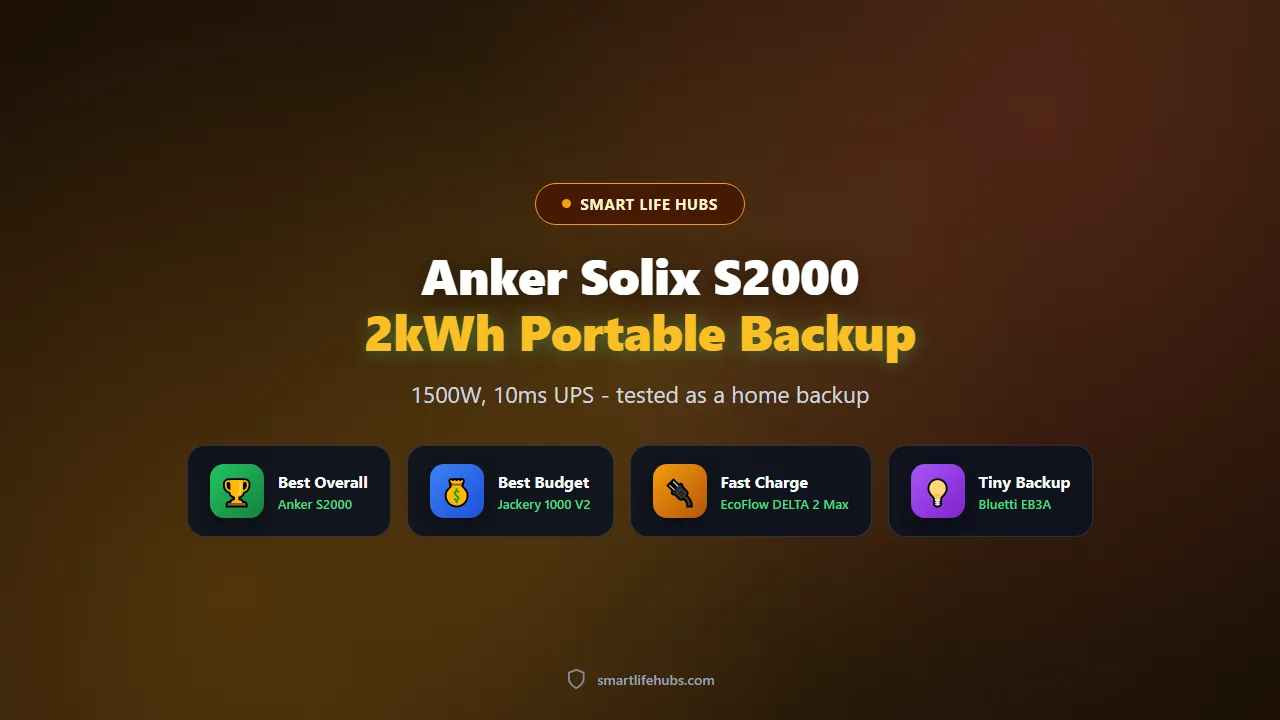
The Anker SOLIX S2000 is a 2,010Wh LiFePO4 power station with a 1,500W continuous and 3,000W surge output, a 10 millisecond UPS switchover and a five-year warranty, in a box that weighs 35.7 pounds. I have used one as a home-office and living-room backup for about two months, and the honest finding is that it is one of the most sensible small home batteries you can buy, and that the list title’s promise about banking cheap power is a stretch, because it is a portable station rather than a grid-arbitrage device.
The second thing to be clear about is what “UPS” means here, because it is the feature that justifies the purchase. The S2000 switches over in about 10 milliseconds, which is fast enough that a desktop computer, a monitor and a modem stay up through a cut without rebooting. That is genuinely useful. What it does not do is arbitrage a time-of-use tariff, because it has no whole-home connection and no automatic schedule that feeds power back to your wiring. It will run essentials from its own outlets, and it will recharge from a wall socket, solar, a generator or a car.
Prices below are US retail captured in November 2026, and the S2000 moves a great deal with sales, sometimes by half in a week.
At a glance
| Product | Best for | Key specs | Price |
|---|---|---|---|
| Anker SOLIX S2000 | Best overall | 2,010Wh LFP, 1,500W continuous, 3,000W surge, 10ms UPS | About 649 to 1,199 USD |
| Jackery Explorer 1000 V2 | Best budget alternative | 1,000Wh, similar output, much cheaper | About half the S2000 price |
| EcoFlow DELTA 2 Max | Best fast-charge alternative | 2,048Wh, 2,400W output, rapid AC charging | About 800 to 1,200 USD |
| Bluetti EB3A | Best tiny backup | 268Wh, 600W, very portable | Under 300 USD |
| Anker SOLIX C1000 Gen 2 | Best step up | 1,024Wh, 2,000W continuous, 600W solar, 10ms UPS | About 500 USD |
The Anker SOLIX S2000 and its closest rivals
1. Anker SOLIX S2000, best overall
The S2000 is the pick in the 2kWh class because it packs the most useful output into the smallest body. The 2,010Wh LiFePO4 battery drives a 1,500W continuous inverter with 3,000W surge, there are five AC outlets split between the front and the back, two USB-C ports at 100W and 15W, one USB-A at 12W, and a 10 millisecond UPS switchover. Anker rates the cells for 10,000 cycles and gives a five-year warranty, and the unit is about 30 percent smaller and 25 percent lighter than the average 2kWh station at 8.2 by 11.1 by 12.7 inches. It charges from a wall outlet at up to 1,150W, from 400W of solar, from a generator, an alternator or a car socket, and Anker says the idle draw is down to 6W, which lets a typical fridge run for around 35 hours.
Pros
- 1,500W output and 3,000W surge from a 35.7 lb box
- 10ms UPS switchover keeps a computer and modem alive
- Five-year warranty and a 10,000 cycle rating
Cons
- Price swings from 649 to 1,199 USD depending on the sale
- 400W solar input is modest for recharging in a day
Check today’s price on Amazon.
2. Jackery Explorer 1000 V2, best budget alternative
The Jackery Explorer 1000 V2 is the honest cheap alternative, and reviewers note that it delivers the same level of output and surge power as the S2000 for about half the price, with the caveat that it has been on the market for longer and has a smaller battery at around 1,000Wh. If you want a station for a few devices during an outage and you do not need the UPS speed or the 2kWh capacity, it is the better value, and the money saved could buy a solar panel.
Pros
- Roughly half the price of the S2000
- Similar output and surge for the money
- Mature product with a large owner base
Cons
- About half the battery capacity
- No 10ms UPS switchover claim
Check today’s price on Amazon.
3. EcoFlow DELTA 2 Max, best fast-charge alternative
The DELTA 2 Max is the pick if you want a bigger inverter and faster recharging. It stores 2,048Wh, delivers 2,400W continuous, and EcoFlow’s fast AC charging can take it from empty to full in a fraction of the time most rivals need, which matters if you are cycling it daily through outages or using it with solar. It is heavier and more expensive than the S2000, and the app is busier, but the extra output covers a wider range of appliances.
Pros
- 2,400W continuous output, well above the S2000
- Very fast AC recharging
- 2,048Wh with a broad accessory ecosystem
Cons
- Heavier and more expensive
- App and feature set are busier than Anker’s
Check today’s price on Amazon.
4. Bluetti EB3A, best tiny backup
The EB3A is the pick for a small, cheap backup that lives in a drawer. It stores about 268Wh, delivers 600W with a 1,200W surge, and weighs around 10 pounds, which makes it the one to keep for a modem, a lamp, a phone and a laptop for an evening. It will not run a fridge for long and it will not run a CPAP all night at high pressure, so treat it as an emergency top-up rather than a home battery.
Pros
- Under 300 USD and about 10 pounds
- Good for a modem, lights, phones and a laptop
- Simple to use and easy to store
Cons
- 600W output rules out most kitchen appliances
- 268Wh is gone quickly with any real load
Check today’s price on Amazon.
5. Anker SOLIX C1000 Gen 2, best step up
The C1000 Gen 2 is the middle option that makes more sense than its price gap suggests. It stores 1,024Wh, delivers 2,000W continuous with a 3,000W peak, takes 600W of solar and switches over in 10 milliseconds, at about 500 USD and 24.9 pounds. That is more output than the S2000 and a faster UPS, for less money, with about half the capacity. If your priority is the inverter rather than the battery, it is the better buy, and it is the model Anker now points US buyers toward in this class.
Pros
- 2,000W continuous and a 10ms UPS switchover
- About 500 USD, below the S2000’s usual street price
- 600W solar input, above the S2000
Cons
- 1,024Wh is half the S2000’s capacity
- No expansion battery, so the capacity is fixed
Check today’s price on Amazon.
How to choose the best 2kWh portable battery
Start with what you actually need to keep running, because the output rating decides that. A 1,500W continuous inverter will run a fridge, a freezer, a modem, a television, a laptop, lights and a phone charger, and it will start most of them. It will not run a kettle, a microwave, a toaster or a space heater on a high setting, and it will struggle with a CPAP at high pressure for a whole night. If your list is mostly electronics and refrigeration, the S2000 is enough. If your list includes kitchen appliances, you need a bigger inverter and probably a different product class.
Then decide whether the UPS speed matters, because it is the S2000’s real advantage. A 10 millisecond switchover keeps a computer and a modem alive, which means no lost work and no reboot. A slower switchover of 20 to 30 milliseconds is fine for lights and a fridge but will reset some computers and most network gear. If you work from home, pay for the fast switchover. If you only want a fridge and some lights, a cheaper station will do.
Check the battery chemistry and the cycle rating, because that is the long-term value. LiFePO4 cells last several times longer than the older NMC chemistry, and Anker rates the S2000 for 10,000 cycles, which is roughly 15 years of daily use. A cheap station with an unrated battery may be fine for occasional outages but will degrade faster if you cycle it daily.
Price the recharging options, because solar input matters more than the headline capacity. The S2000 takes 400W of solar, which means a full recharge from two 200W panels in a few hours of good sun, and a wall charge at up to 1,150W in about two hours. If you want to run off-grid for days, the solar input and the panel cost are the deciding factors, not the battery size.
Finally, be honest about the energy-arbitrage claim. A portable station cannot feed power back to your house wiring, so it cannot shift cheap overnight electricity into your evening loads the way a whole-home battery can. What it can do is charge overnight on a cheap tariff and power your essentials through the day, which is a smaller but real saving. A full independent review at pcmag.com/reviews/anker-solix-s2000 tests the output, the surge behaviour and the app in more detail, and for genuine whole-home arbitrage, look at the Anker SOLIX E10 or the EcoFlow Stream Ultra X, both of which connect to the house wiring.
Living with the S2000
Place it somewhere you will actually use it, because a battery in a closet is a battery you forget. A living-room corner, under a desk or in a utility room near an outlet is ideal, and it should be somewhere with airflow rather than sealed in a cabinet. It is quiet, so a bedroom is possible, but it is not silent under load.
Charge it before you need it and keep it topped up. LiFePO4 is happy at any state of charge, so there is no need to cycle it deliberately, but a battery that has sat empty for six months may have tripped its protection. Check it monthly, top it up to around 80 percent, and run a short discharge once every few months to keep the inverter exercised.
Label what you will plug in, and keep the cables nearby. In an outage you do not want to be hunting for the right adapter, so decide in advance which devices go on the S2000 and keep a short strip or a set of cables with it. Do not plug it into a surge strip that also feeds a heater or a kettle, because you will trip the inverter.
Use the app to set the charge limit and the idle behaviour. Keeping the battery at 80 percent rather than 100 extends its life, and lowering the idle draw matters if you are running a low load overnight. The app will also tell you the runtime estimate for the current load, which is the number to trust rather than the capacity claim.
Do not rely on it as the only plan. A 2kWh battery is a comfort tool for a short outage, not a replacement for a generator or a whole-home system. If outages are long and frequent where you live, a generator or a wired battery will serve you better, and the S2000 becomes the backup for the backup.
Frequently asked questions
Frequently Asked Questions
6Can the Anker SOLIX S2000 run a refrigerator?
Yes, and for a long time. Anker says the low idle draw of 6W and the efficient inverter let a typical fridge run for around 35 hours on a full charge, depending on the model and the room temperature. Fridges cycle on and off, so the real runtime is usually longer than the naive calculation.
Is the S2000 a real UPS?
It is a UPS for the devices plugged into it, with a switchover of about 10 milliseconds, which keeps a computer and a modem up. It is not a whole-home UPS, because it only powers its own outlets.
How long does the S2000 take to charge?
From a wall outlet at up to 1,150W it takes roughly two to two and a half hours. From 400W of solar it takes three to four hours in good sun. It can also charge from a generator, an alternator or a car socket.
Can I use the S2000 to save money on a time-of-use tariff?
Only in a limited way. It can charge overnight on a cheap tariff and power your essentials during the day, but it cannot export to your house wiring, so it will not shift power to the rest of the home the way a wired battery can.
How long will the battery last?
Anker rates the LiFePO4 cells for 10,000 cycles and gives a five-year warranty. On a daily cycle that is roughly 15 years before the battery reaches 70 percent capacity, and occasional use will last longer.
Can I take the S2000 camping or in a car?
Yes. At 35.7 pounds it is portable enough for a car trunk or a campsite, and it has grab handles and a broad operating temperature range. It is heavier than a small camping unit, so it suits car camping rather than backpacking.
The bottom line
The Anker SOLIX S2000 is the best 2kWh portable battery in 2026 if you want a fast UPS switchover, a 1,500W output and a five-year warranty in a 35.7 pound box. It is the most sensible way to keep a home office, a fridge and a modem alive through an outage, and the LiFePO4 chemistry means it should still be working in fifteen years.
The list title’s claim about banking cheap power is overstated, and it is worth being plain about that. A portable station cannot export to your house wiring, so it does not arbitrage a tariff the way a wired battery does. What it can do is charge overnight on a cheap rate and carry your essentials through the day, which is a smaller saving than the title suggests.
On a budget, the Jackery Explorer 1000 V2 gives you similar output for about half the money with half the capacity, and the Bluetti EB3A is the tiny option for a modem and some lights. If you want more output and faster charging, the EcoFlow DELTA 2 Max is the step up. And if you actually want whole-home coverage or genuine arbitrage, the Anker SOLIX E10 or the EcoFlow Stream Ultra X are the products to look at instead.


Leave a Comment