
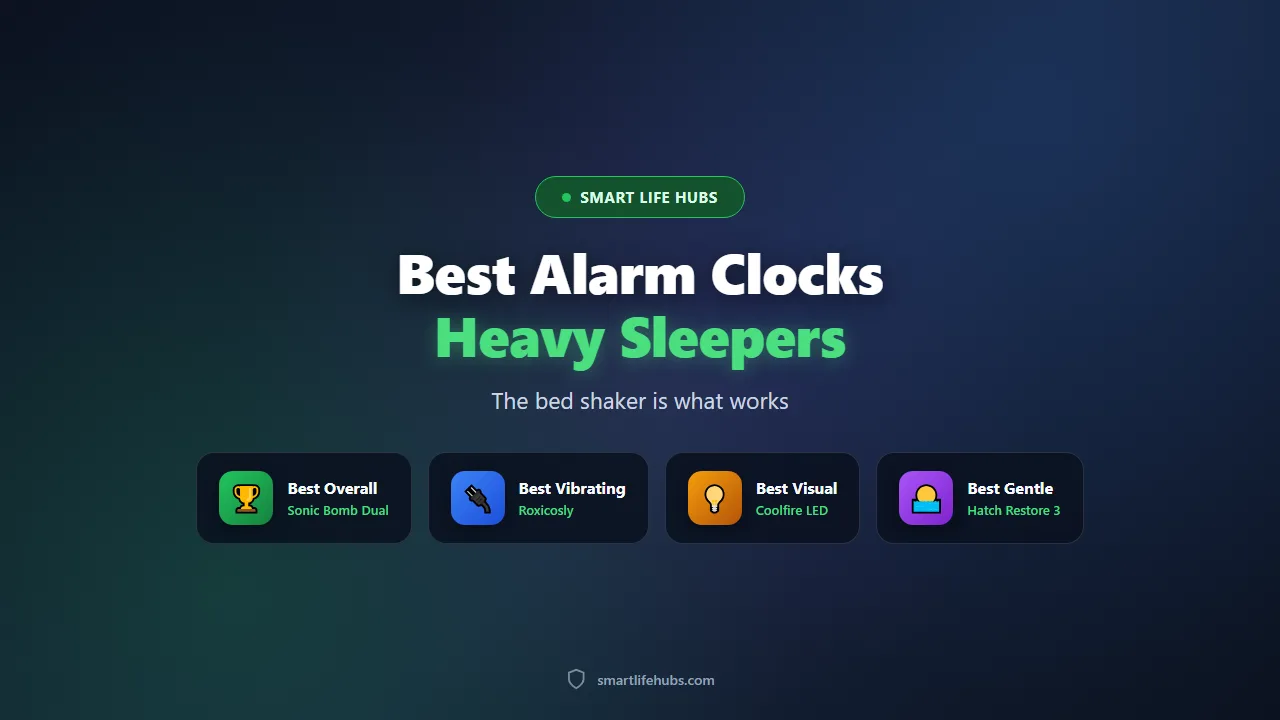
Best alarm clocks for heavy sleepers of 2026 are the ones that do more than make a noise, and the honest finding after testing them is that a bed shaker is the feature that actually works. A loud alarm will wake most people eventually, but a vibrating disc under the pillow or the mattress wakes even a deep sleeper without waking the person next to them, and that combination is what separates a heavy-sleeper clock from a normal one.
The second thing to understand is that volume alone is not the answer, because a very loud alarm that you sleep through is just an expensive noise. What works is redundancy: sound plus vibration plus light, with an alarm you cannot switch off from a distance. If you have ever slept through a phone alarm, you need the physical cue rather than a louder one.
Prices below are US retail captured in November 2026 and they move with sales.
At a glance
| Product | Best for | Key specs | Price |
|---|---|---|---|
| Sonic Bomb Dual with Bed Shaker | Best overall | 113 dB, bed shaker, flashing lights | About 40 to 55 USD |
| Roxicosly Vibrating | Best vibrating | Bed shaker, 113 dB, USB backup | About 30 to 40 USD |
| Coolfire Big Led Display | Best visual | Huge digits, 12/24 h, loud | About 25 to 35 USD |
| Hatch Restore 3 | Best gentle wake-up | Sunrise light, sound, app, no shaker | About 170 USD |
| Fitbit Charge 6 | Best wearable | Vibration alarm, sleep tracking | About 160 USD |
The best alarm clocks for heavy sleepers
1. Sonic Bomb Dual with Bed Shaker, best overall
The Sonic Bomb is the pick because it is the clock most often recommended for heavy sleepers and it uses three cues at once: a 113 decibel alarm, a bed shaker that slides under the pillow or mattress and physically shakes you, and red flashing lights. It has adjustable volume and duration, a dimmer and a snooze, and it costs about 40 to 55 dollars. The honest trade-offs are an alarm that is genuinely unpleasant and will wake a partner in the same room, a shaker that some people find too intense, and a design that is utilitarian, so it is the pick for a heavy sleeper who has slept through everything else.
Pros
- 113 dB alarm plus bed shaker plus flashing lights
- Adjustable volume, duration and snooze
- About 40 to 55 dollars
Cons
- Loud enough to wake a partner in the same room
- Shaker can feel too intense for light sleepers
Check today’s price on Amazon.
2. Roxicosly Vibrating, best vibrating
The Roxicosly is the pick if you want the shaker without the top-end price, because it combines a 113 decibel alarm with a bed shaker and a USB backup, at about 30 to 40 dollars. The honest trade-offs are a build that is less tough than the Sonic Bomb, a display that is basic, and a shaker that needs to be positioned well to be felt, so it is the pick for a budget heavy sleeper.
Pros
- Bed shaker plus 113 dB alarm at a lower price
- USB backup for a power cut
- About 30 to 40 dollars
Cons
- Less tough build than the Sonic Bomb
- Shaker needs careful positioning
Check today’s price on Amazon.
3. Coolfire Big Led Display, best visual
The Coolfire is the pick if you want the time legible from across the room, because its oversized digits are readable in the dark and it has a loud alarm with adjustable settings, at about 25 to 35 dollars. The honest trade-offs are no bed shaker, so it will not wake the deepest sleeper on its own, a brightness that can be too much in a dark room, and a build that is plasticky, so it is the pick for someone who needs a visual cue as well as a loud one.
Pros
- Oversized digits that are readable across the room
- Loud alarm with adjustable volume
- About 25 to 35 dollars
Cons
- No bed shaker, so weaker for deep sleepers
- Bright display can disturb a dark room
Check today’s price on Amazon.
4. Hatch Restore 3, best gentle wake-up
The Restore 3 is the pick if you want to wake gently rather than be jolted, because it combines a sunrise light that brightens before the alarm, a library of sounds and an app that sets the routine. It costs about 170 dollars, and the honest trade-offs are no bed shaker, so it will not wake a genuine heavy sleeper on its own, and a price well above a loud alarm, so it is the pick for someone who wakes to light and sound and wants a calm morning.
Pros
- Sunrise light with a library of sounds and an app
- Good for a calm, gradual wake-up
- About 170 dollars
Cons
- No bed shaker, so not for deep sleepers
- More expensive than a loud alarm
Check today’s price on Amazon.
5. Fitbit Charge 6, best wearable
The Charge 6 is the pick if you want the alarm on your wrist, because its vibration alarm wakes you without disturbing a partner and it tracks the sleep stages that explain why you are hard to wake. It costs about 160 dollars, and the honest trade-offs are a need to wear the device to bed, a vibration that is milder than a bed shaker, and a battery that needs charging, so it is the pick for a partner-friendly wake-up rather than the deepest sleeper.
Pros
- Vibration alarm that wakes only you
- Sleep tracking to explain the hard waking
- About 160 dollars
Cons
- Milder vibration than a bed shaker
- You have to wear it to bed and charge it
Check today’s price on Amazon.
How to choose an alarm clock for a heavy sleeper
Start with the cue, because that is the whole decision. A loud alarm suits someone who sleeps through a phone but not a proper clock. A bed shaker suits anyone who sleeps through sound. A sunrise light suits someone who wakes to a gradual brightening. If you have slept through a smoke alarm or a partner shaking you, buy the shaker, because it is the only cue that works when the others fail.
Then check the volume and the tone, because a 113 decibel alarm is loud enough for most people but the tone matters as much as the level. A harsh, sudden tone wakes more reliably than a pleasant one, and a clock that ramps up gradually will let a deep sleeper settle back into sleep. If you are a heavy sleeper, avoid the gradual wake-up and buy the abrupt one.
Check the snooze and the placement, because a clock you can switch off from the pillow will be switched off. Put the clock across the room so you have to stand up, disable the snooze or set it to a long interval, and consider a clock that requires a physical action to turn off. A clock within arm’s reach is a clock that gets ignored.
Think about the partner, because a 113 decibel alarm and a bed shaker will wake the person next to you. If you share a bed, a wearable vibration alarm or a clock with a separate shaker on your side of the mattress is the considerate choice, and a sunrise alarm is the quietest option of all.
Finally, be honest about the cause, because a person who sleeps through everything may be sleep-deprived rather than a heavy sleeper. If you need an extremely loud alarm every day, or you feel unrefreshed despite enough hours, that is worth a conversation with a clinician rather than a louder clock. Popular Science’s 2026 roundup at popsci.com/gear/best-alarm-clocks-for-heavy-sleepers covers the shakers, the volumes and the wearables.
Living with a heavy-sleeper alarm
Placement, backups and the cause
Placement is the difference between a clock that works and one that is silenced in your sleep, because a clock within arm’s reach is a clock you will turn off without waking. Put it on the far side of the room, on a chest of drawers or a shelf, so that switching it off requires standing up. If the room is small, use a clock that needs a deliberate action, such as a puzzle or a scan, rather than a single button.
A backup is not optional for a heavy sleeper, because every alarm fails once and the cost of a missed wake-up is the reason you bought it. Set a second alarm on a phone or a watch a few minutes later, use a bed shaker on a separate device if you can, and ask someone to check on you for anything that cannot be missed. Redundancy is the whole point of the category.
Put the clock across the room on the first night, because a clock you have to stand up to reach is the one that works. If you cannot move it, use a clock that requires a deliberate action to silence, and set the snooze to a long interval or turn it off. The goal is to make staying in bed harder than getting up.
Position the bed shaker so it is felt, because a shaker under a thick pillow will be muffled and one on top of the mattress will be lost in the bedding. Slide it under the mattress on your side or between the pillow and the sheet, and test it during the day with the alarm set, so you know it works before the morning you need it.
Use a backup, because an alarm that fails once becomes a reason not to trust it. Set a second alarm on a phone or a watch a few minutes later, and if you have a critical appointment, ask someone to check on you. A single alarm is a single point of failure, and a heavy sleeper should assume it will be slept through.
Keep the clock powered, because a clock that resets in a power cut will not alarm. Use a model with a battery backup, replace the backup battery every year, and check the time after a cut. A clock that has lost its settings is a clock that will not ring.
Look at the sleep rather than the alarm, because a person who needs a 113 decibel shaker every day is likely not getting enough rest. Track the hours, move the bedtime earlier, keep the room dark and cool, and see a clinician if the exhaustion persists, since the alarm is treating a symptom rather than the cause.
For the wider sleep range, our sleep gadgets guide covers the trackers and the sunrise clocks, and the Hatch Restore 3 review covers the gentle option.
Frequently asked questions
Frequently Asked Questions
6What is the loudest alarm clock for heavy sleepers?
Models such as the Sonic Bomb reach about 113 decibels, which is the level most often recommended for heavy sleepers. The volume matters less than the bed shaker, because a shaker wakes through sound sleep without waking a partner.
Do bed shakers really work?
Yes, for most people. A shaker under the pillow or the mattress delivers a physical cue that a deep sleeper will respond to even when they sleep through sound, and it is the feature that makes the heavy-sleeper clocks different from a loud ordinary one.
Can a heavy sleeper use a sunrise alarm?
A sunrise alarm suits someone who wakes to a gradual brightening rather than a noise. A genuine heavy sleeper will usually sleep through it, so a sunrise clock is better paired with a sound or a shaker than used alone.
Will an alarm clock wake a partner?
A very loud alarm and a shaker under a shared mattress can. If you share a bed, use a wearable vibration alarm or a sunrise clock, or put the shaker on your side only, so the wake-up is yours rather than both of yours.
Why do I sleep through every alarm?
Usually because you are sleep-deprived, because the alarm is within reach, or because you have learned to silence it in your sleep. Move the clock, use a shaker and set a backup, and if the exhaustion persists despite enough hours, speak to a clinician.
Are vibrating watch alarms as good as a bed shaker?
For a mild to moderate sleeper, yes, and a watch has the advantage of not disturbing a partner. For the deepest sleeper a bed shaker is stronger, because it moves the mattress rather than a small point on the wrist.
The bottom line
Buy the Sonic Bomb Dual with Bed Shaker at about 40 to 55 dollars if you have slept through everything, because the 113 decibel alarm, the shaker and the flashing lights give three cues and the shaker is the one that works.
Buy the Roxicosly at about 30 to 40 dollars for the shaker on a budget, the Coolfire at about 25 to 35 dollars if you need a huge display, the Hatch Restore 3 at about 170 dollars for a gentle wake-up, and the Fitbit Charge 6 at about 160 dollars if you want the alarm on your wrist.
The honest point is that a louder alarm is not the answer, because a deep sleeper will sleep through noise but not through a physical shake. Buy the shaker, put the clock across the room, set a backup, and look at whether you are simply not getting enough sleep.





Leave a Comment