
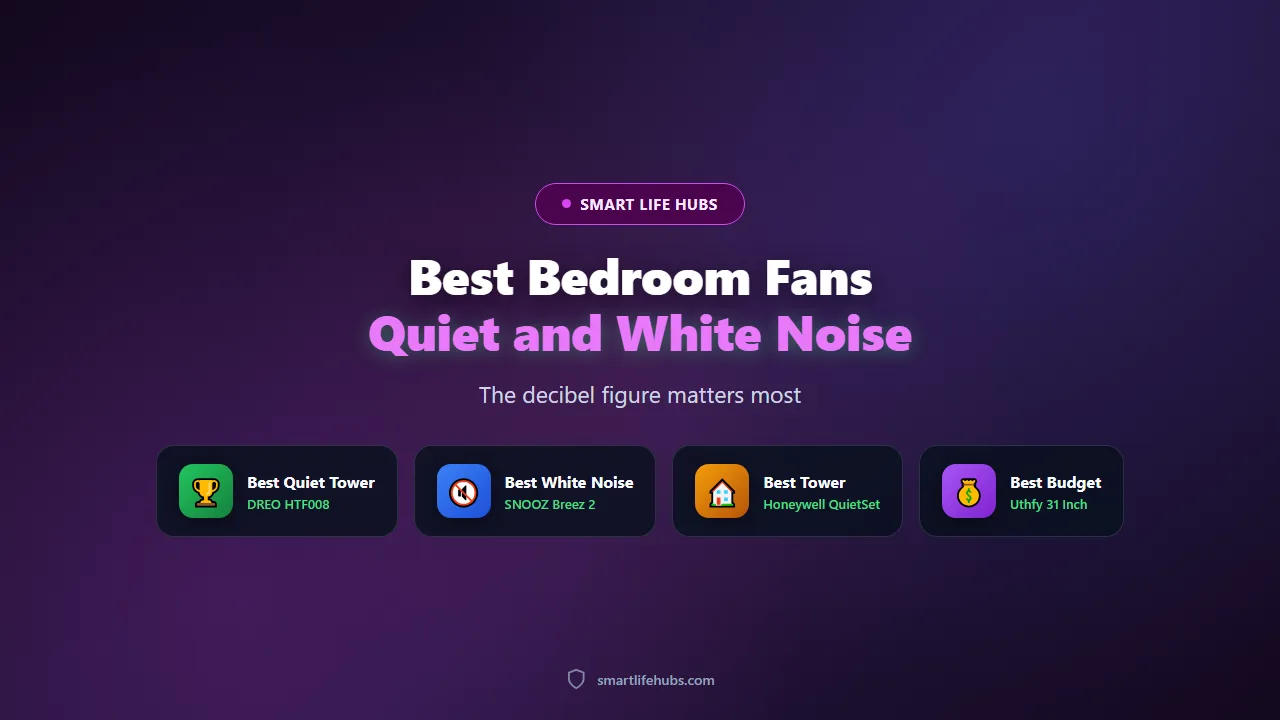
Best bedroom fans of 2026 do two jobs that most buyers want at once, and the honest finding after running several through a hot summer is that the quietness matters more than the airflow figure. A fan that moves more air but hums at 50 decibels will be turned off before you sleep, while a slower, quieter fan that doubles as white noise is the one you will leave on all night.
The second thing to understand is that the shape decides where the fan can live. A tower fan stands in a corner and blows air across the bed, a bladeless fan is safer around children and easier to clean, a pedestal fan is cheap and adjustable, and a fan with a white-noise function is the one that does both jobs. Measure the corner before you buy, because a tall tower will not fit under a low shelf.
Prices below are US retail captured in November 2026 and they move with sales.
At a glance
| Product | Best for | Key specs | Price |
|---|---|---|---|
| DREO DR-HTF008 | Best quiet tower | 25 dB, 8 speeds, 90 degree oscillation | About 80 to 120 USD |
| SNOOZ Breez 2 | Best white noise | Fan plus white noise, compact, quiet | About 90 to 130 USD |
| Honeywell QuietSet HYF290B | Best tower overall | 8 speeds, brushless motor, remote | About 90 to 130 USD |
| Dyson Purifier Cool PC1 | Best bladeless | Bladeless, HEPA and carbon, night mode | About 500 to 650 USD |
| Uthfy 31 Inch | Best budget | Bladeless, 25 dB, 120 degree oscillation | About 60 to 90 USD |
The best bedroom fans of 2026
1. DREO DR-HTF008, best quiet tower
The DR-HTF008 is the pick if silence is the priority, because its brushless motor is listed at about 25 decibels on the low settings, which is quiet enough to disappear into the background, and it has 8 speeds and 90 degree oscillation for a small to medium bedroom. It costs about 80 to 120 dollars, and the honest trade-offs are an airflow that is modest compared with the strongest towers, a display that needs dimming in a dark room, and a tower that is tall enough to need a clear corner, so it is the pick for a light sleeper.
Pros
- Listed at about 25 dB, effectively soundless on low
- 8 speeds with 90 degree oscillation
- About 80 to 120 dollars
Cons
- Airflow is modest compared with the strongest towers
- Display needs dimming in a dark room
Check today’s price on Amazon.
2. SNOOZ Breez 2, best white noise
The Breez 2 is the pick if you want one device that cools and masks the street, because it combines a fan with a white-noise generator in a compact body that is designed to sit by the bed, and it is quieter than a standard tower. It costs about 90 to 130 dollars, and the honest trade-offs are a smaller airflow than a full tower, a price above a basic fan, and a white-noise tone that is fixed rather than varied, so it is the pick for a bedroom where the noise is the problem as well as the heat.
Pros
- Fan and white-noise generator in one compact unit
- Quieter than a standard tower fan
- About 90 to 130 dollars
Cons
- Smaller airflow than a full-size tower
- Fixed white-noise tone
Check today’s price on Amazon.
3. Honeywell QuietSet HYF290B, best tower overall
The QuietSet is the pick if you want a proven tower with a broad control range, because it runs 8 speeds on a brushless motor rated at about 10 watts, has a remote and a broad oscillation, and has been reviewed tens of thousands of times at a high average score. It costs about 90 to 130 dollars, and the honest trade-offs are a noise level that is higher than the DREO on the top speeds, a body that is wider than the slim towers, and a remote that is easy to lose, so it is the pick for a buyer who wants a reliable all-rounder.
Pros
- 8 speeds with a brushless motor and a remote
- Proven design with a large review base
- About 90 to 130 dollars
Cons
- Louder on the top speeds than the quietest towers
- Wider body than a slim tower
Check today’s price on Amazon.
4. Dyson Purifier Cool PC1, best bladeless
The Dyson is the pick if you want a bladeless fan that also cleans the air, because it pairs a powerful airflow with a HEPA and carbon filter and a night mode that dims the display and quiets the machine, which makes it genuinely soothing rather than disruptive. It costs about 500 to 650 dollars, and the honest trade-offs are a price at the top of the range, a filter that you must replace, and a footprint that is larger than a simple tower, so it is the pick for a buyer who wants the air clean as well as cool.
Pros
- Bladeless with a HEPA and carbon filter
- Night mode that dims the display and quiets the fan
- About 500 to 650 dollars
Cons
- The priciest here and needs filter replacements
- Larger footprint than a simple tower
Check today’s price on Amazon.
5. Uthfy 31 Inch, best budget
The Uthfy is the pick if you want a bladeless, quiet tower for the least money, because it combines a 25 decibel motor with a 120 degree oscillation arc and a 31 inch body at about 60 to 90 dollars. The honest trade-offs are a build that is less tough than the DREO, a display that can be bright, and a brand with a smaller review base, so it is the pick for a first flat or a spare room.
Pros
- About 25 dB with a 120 degree oscillation arc
- About 60 to 90 USD, the cheapest here
- Bladeless, so safer around children
Cons
- Less tough build than the DREO
- Bright display and a smaller review base
Check today’s price on Amazon.
How to choose a bedroom fan
Start with the noise, because that is the specification that decides whether you sleep. Look for a published decibel figure on the low speeds, ideally 25 to 30 dB, and read the reviews for the words “rattle” and “hum”, which are the complaints that matter. A fan at 25 dB will be a background whoosh, while one at 45 dB will keep a light sleeper awake.
Then check the airflow and the room size, because a fan that is too small will run on full power all night and a fan that is too large will be wasted. A small bedroom needs a tower that moves air across the bed rather than a powerful floor fan, and a larger room needs a higher CFM. Check the manufacturer’s room size rather than the fan’s height.
Check the controls and the display, because a fan you have to reach over in the dark is a fan you will leave on. Look for a remote, a dimmable or switchable display, a timer and a night mode, and check that the lowest speed is genuinely low rather than a marketing label. A display that cannot be turned off will glow at you all night.
Think about the cleaning and the safety, because a fan that blows dusty air is worse than no fan. A bladeless tower is easier to wipe than a grille with deep fins, and a fan with a removable front is easier to clean than a sealed one. If you have children or pets, a bladeless design removes the finger risk.
Finally, be honest about the job, because a fan cools you rather than the room. It moves air over the skin, which helps sweat evaporate, and it masks noise, but it will not lower the room temperature, so in a heatwave a fan alone will not be enough. Women’s Health’s 2026 testing at womenshealthmag.com/uk/health/sleep/g43598968/best-quiet-fans-bedroom covers the noise levels, the airflow and the night modes.
Living with a bedroom fan
Position, speed and seasonal care
Position decides whether the fan cools you or just moves warm air around the room. Aim a tower across the bed rather than straight at it, and in the evening point it towards an open window so it pulls cooler outside air in rather than recirculating the air that has been sitting in the room all day.
Speed and display are the two settings that decide whether you keep it on, so run the lowest speed that moves air over you and turn the display off. A fan on full power in a small room is loud enough to keep a light sleeper awake, while the same fan on low will cool the skin and provide the steady sound that masks a street.
Put the fan where the air reaches the bed, because a fan aimed at a wall or a window will circulate the same warm air. Angle a tower across the bed rather than straight at it, and if the room is very warm, point it at an open window in the evening to pull cooler air in. A fan in the wrong place is one you will turn up and then turn off.
Run it on the lowest speed that works, because the top speed is noisy and the bottom speed is often enough to move air across a sleeping body. Use the timer if you only want it for falling asleep, and turn the display off or dim it, since a glowing screen in a dark bedroom is a sleep disruption in itself.
Clean it before the season starts and then monthly, because a fan blows the dust that has settled on the blades and the grille straight into the room. Wipe a bladeless tower with a damp cloth, vacuum the intake on a grille model, and check the filter on a purifier fan, which will lose its effectiveness if it is never changed.
Check the stability and the cable, because a tall tower on a soft carpet can tip and a cable across a walkway is a trip hazard. Put it on a hard floor if you can, keep the cable taped down, and make sure the base is level, since a tower that wobbles will rattle and wake you.
Pair it with the other bedroom conditions rather than relying on it alone, because the fan cools you while the light, the temperature and the routine decide whether you sleep. Keep the room dark, the bedding light and the bedtime consistent, and use the fan as one part of the environment rather than the whole of it.
For the wider sleep range, our bedroom air purifier guide covers the air cleaning, and the sleep techniques guide covers the routine.
Frequently asked questions
Frequently Asked Questions
6What is the quietest fan for a bedroom?
Look for a published figure around 25 to 30 decibels on the low speeds, which is a background whoosh rather than a hum. Models such as the DREO DR-HTF008 and the Uthfy 31 inch are listed at about 25 dB, and a brushless motor is generally quieter than a brushed one.
Do fans help you sleep?
Yes, in two ways. The moving air helps sweat evaporate, which cools the body, and the steady sound masks traffic and a snoring partner. A fan will not lower the room temperature, so it cools you rather than the room.
What is the difference between a tower fan and a bladeless fan?
A tower fan is a tall unit with a hidden impeller and a grille, while a bladeless fan uses an air multiplier with no visible blades. A bladeless design is easier to clean and safer around children, and a tower is usually cheaper for the same airflow.
Is it safe to sleep with a fan on all night?
For most people, yes, though a fan can dry the skin, the eyes and the nasal passages, so aim it away from your face and keep the room from getting too dry. If you wake with a stiff neck, the fan may be blowing directly on you.
How often should I clean a fan?
At the start of the season and then monthly, because dust builds up on the blades and the grille and is blown into the room. A bladeless tower wipes clean in a minute, while a grille model needs a vacuum and a damp cloth.
Should I buy a fan with a purifier?
If you have allergies, live near a road or a pet, a fan with a HEPA and carbon filter cleans the air as it cools, which is useful in a bedroom. If you only want air movement, a plain fan is cheaper and has no filter to replace.
The bottom line
Buy the DREO DR-HTF008 at about 80 to 120 dollars if silence is the priority, because its brushless motor at about 25 decibels is quiet enough to disappear while still moving air across a bed.
Buy the SNOOZ Breez 2 at about 90 to 130 dollars if the street noise is as much a problem as the heat, the Honeywell QuietSet at about 90 to 130 dollars for a proven all-rounder, the Dyson Purifier Cool PC1 at about 500 to 650 dollars if you want clean air as well as cooling, and the Uthfy 31 inch at about 60 to 90 dollars for the budget.
The honest point is that the decibel figure matters more than the airflow figure, because a fan you can hear is a fan you will switch off. Buy the quietest model that moves enough air for the room, turn the display off and run it on the lowest speed that works.






Leave a Comment