
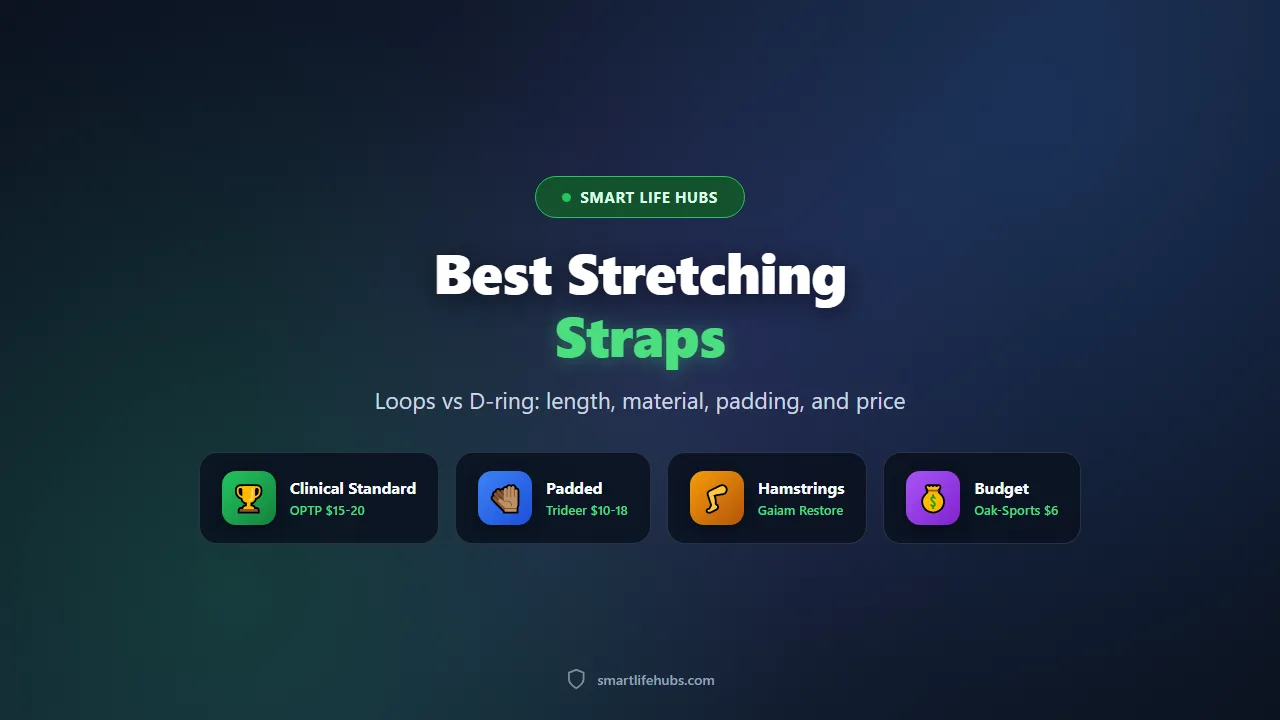
A stretching strap is a length of non-stretch webbing with loops or a buckle that lets you hold a stretch you cannot reach, and it is one of the cheapest and most effective mobility tools there is. The two designs are a loop strap, which lets you advance through positions without re-gripping, and a D-ring buckle strap, which is simpler and cheaper and suits yoga and general flexibility work.
Prices run from about $6 to $25, which means the whole category costs less than a pair of shoes. The OPTP Original Stretch Out Strap at $15 to $20 is the clinical standard, the Trideer at $10 to $18 is the best padded option, the Gaiam Restore at $10 to $15 is the best for hamstrings, and the Oak-Sports at about $6 is the cheapest worth buying.
I pulled MyExercisePlan’s reviewed yoga strap guide, Square Foot Athlete’s apartment mobility picks, Best Resistance Band Sets’ comparison, Pilates Collective Club’s live-checked price list and StrongRanked’s ranked category list. Where a figure is a claim rather than a measurement, I say so. Prices are US street prices as of November 2026.
At a glance
| Product | Best for | Key specs | Price |
|---|---|---|---|
| OPTP Original Stretch Out Strap | Best overall | 6 ft woven nylon, 10 loops, made in the USA, exercise book | About $15 to $20 |
| Trideer Stretching Strap with Loops | Best padded | 75 inch non-elastic, 10 loops, neoprene anti-chafe grips | About $10 to $18 |
| Gaiam Restore Multi-Grip | Best for hamstrings | 86 inch nylon, EVA foam grips, dedicated foot strap design | About $10 to $15 |
| Gaiam D-Ring Yoga Strap | Best simple | 8 ft polyester, adjustable D-ring buckle, no loops | About $9 |
| Oak-Sports 10-Loop Strap | Best budget | 75 inch, 10 loops, woven fabric | About $6 |
The best stretching straps of 2026
1. OPTP Original Stretch Out Strap, best overall
The OPTP Original Stretch Out Strap costs about $15 to $20 and it is the strap physical therapists recommend. It was the first stretching strap on the market in 1993, uses a patented 10-loop woven nylon design that lets you hold a stretch and advance to the next loop without re-gripping, and ships with an exercise book covering hamstrings, shoulders and hips. MyExercisePlan scores it 9.8 out of 10 as the best overall, and Square Foot Athlete notes more than 27,000 reviews behind it.
The trade-offs are the length and the material. At 6 feet it is shorter than some, so taller users should look at the XL at 7 foot 5, and the nylon has a slightly slick feel when your hands are damp.
- Pros: About $15 to $20; 10 loops; made in the USA; exercise book; 27,000-plus reviews
- Cons: 6 ft is short for tall users; nylon feels slick with damp hands
Check today’s price on Amazon.
2. Trideer Stretching Strap with Loops, best padded
The Trideer Stretching Strap costs about $10 to $18 and it is the option for people with sensitive hands or arthritis. It is a 75 inch non-elastic polypropylene strap with 10 loops and neoprene padded grips, and MyExercisePlan recommends it as the budget pick for home rehab, noting the loops give a firm hold for hamstring, quad and shoulder stretches without the webbing stretching back at you.
The trade-off is the grip in damp conditions, because the polypropylene is slicker than cotton. If you stretch after a sweaty workout, the padded grips help, but cotton or nylon will hold better.
- Pros: About $10 to $18; neoprene padding; 10 loops; non-elastic; 75 inch length
- Cons: Polypropylene is slick when damp; padding adds bulk
Check today’s price on Amazon.
3. Gaiam Restore Multi-Grip, best for hamstrings
The Gaiam Restore Multi-Grip Stretch Strap costs about $10 to $15 and it is the strap designed around the hamstrings and calves. It is an 86 inch nylon strap with EVA foam grips and a dedicated foot strap design, and Square Foot Athlete calls it a strong budget alternative with a foot loop that is genuinely useful for hamstring work specifically. StrongRanked lists the 86 by 1.5 inch strap with an exercise guide included.
The trade-offs are that the foot loop makes it more specialised than a plain loop strap, and it is a consumer product rather than a clinical one. For hamstring and calf work it is excellent, and for general yoga it is less flexible.
- Pros: About $10 to $15; 86 inch; EVA foam grips; foot strap; guide included
- Cons: More specialised than a loop strap; lighter build than OPTP
Check today’s price on Amazon.
4. Gaiam D-Ring Yoga Strap, best simple
The Gaiam D-Ring Yoga Strap costs about $9 and it is the simplest design here: an 8 foot polyester strap with a double D-ring cinch buckle and no loops. Pilates Collective Club confirms the live price and notes that the D-ring closure holds a fixed position under tension without slipping, while the 8 foot length gives enough working length for supine hamstring and quad stretches even for taller practitioners.
The trade-offs are that you must re-adjust to change position rather than stepping to the next loop, and the webbing is a polyester blend rather than the heavier nylon of the OPTP. For yoga and general flexibility it is entirely adequate.
- Pros: About $9; 8 ft; D-ring holds under tension; simple and cheap
- Cons: No loops, so re-gripping; lighter webbing; less precise progression
Check today’s price on Amazon.
5. Oak-Sports 10-Loop Strap, best budget
The Oak-Sports 10-Loop Strap costs about $6 and it is the cheapest loop strap worth buying. Pilates Collective Club confirmed it in stock at $5.86 as a 75 inch, 10-loop strap, and it does the same job as the OPTP at a third of the price. For a first strap, a travel strap or a spare to leave in a gym bag, it is the sensible buy.
The trade-offs are the build quality and the stitching, which will not last as long as the made-in-USA OPTP, and the absence of an exercise guide. If you stretch daily for years, the OPTP is the better long-term value.
- Pros: About $6; 75 inch; 10 loops; cheapest way to try
- Cons: Basic stitching; no guide; shorter life than the clinical straps
Check today’s price on Amazon.
Five strap stretches worth doing
The supine hamstring stretch is the one most people need. Lie on your back, loop the strap around the ball of one foot, straighten the leg toward the ceiling and gently pull the strap until you feel the pull behind the knee and thigh. Keep the other leg flat or bent, and hold for 30 to 60 seconds. This is the stretch that helps with lower back tightness more than any other.
The shoulder extension works the chest and the front of the shoulder. Hold the strap behind your back with both hands, straighten your arms and lift them slowly away from your body, keeping your chest open. People who sit at a desk all day need this more than they realise.
The quad stretch is easiest on your side. Lie on one side, loop the strap around the top foot of the upper leg, bend the knee and pull the heel toward the glute. The strap lets you control the intensity without using your hands behind your back, which is awkward for most people.
The figure-four stretch targets the glutes and piriformis. Lie on your back with both knees bent, cross one ankle over the opposite knee, loop the strap around the thigh of the supporting leg and pull toward your chest. This is the stretch that helps with sciatic-type tightness down the leg.
The neck release should be gentle. Sit upright, loop the strap lightly around the back of the head, hold both ends and let the weight of your arms provide a mild traction while you slowly tilt the chin toward the chest. Never pull hard on the neck, and stop if you feel dizzy.
Living with a stretching strap
The first thing you learn is that the strap only works if you use it, and the easiest way to use it is to leave it where you stretch. A strap by the sofa or on the bed gets used while you watch television, and one in a drawer does not.
The second is that the loops are what make a strap useful. Being able to hold a stretch, then reach the next loop and hold again, lets you progress through a range of motion in one session without letting go, and that is the whole reason the OPTP design has lasted since 1993.
The third is that a strap does not make a stretch more intense, it makes it controllable. You should feel a moderate pull, not pain, and the strap lets you find that point precisely rather than forcing it with a towel or a belt.
The fourth is duration. A strap-assisted stretch held for 30 to 60 seconds is more useful than a few seconds of yanking, and the strap makes holding that long comfortable.
The fifth is that a strap is a mobility tool, not a treatment. It helps with flexibility and can support rehab exercises, but it will not fix a limitation on its own, and pain that persists belongs with a physiotherapist.
The short version is that a strap turns a stretch you skip into a stretch you hold, and that is where the benefit comes from.
How to choose a stretching strap
Pick loops or a buckle. A loop strap lets you progress through a range of motion without re-gripping, which suits physical therapy and progressive stretching. A D-ring buckle strap is simpler and cheaper and suits yoga and general flexibility work.
Check the length. Six feet suits most people, 7 to 8 feet suits taller users and supine hamstring stretches, and 10 feet suits yoga poses that need a long reach. If you are over about six foot, buy the longer option.
Check the material. Woven nylon is the most durable and the standard in clinics, cotton is softer and grips better but wears faster, and polypropylene is light and cheap but slick when damp. Match the material to how sweaty your sessions get.
Think about your hands. If you have arthritis or sensitive hands, padded neoprene grips such as the Trideer make a real difference. If your hands are fine, plain webbing is lighter and packs smaller.
Look at what is included. The OPTP and some others ship with an exercise book or video guide, which matters if you do not know which stretches to do. If you already have a programme, it is a nice extra rather than a reason to pay more.
Match it to the stretch. For hamstrings and calves, a foot loop design helps. For shoulders and hips, loops let you progress. For yoga, a long D-ring strap is the traditional choice.
Do not overpay. The category tops out around $25, and a $6 strap does most of the job. Buy the length and design you need and spend the rest of the budget on consistency.
Think about the rest of the kit. Our massage ball guide covers the pressure side of mobility, and our fitness tracker roundup covers the training that creates the tightness.
Frequently asked questions
Frequently Asked Questions
6What is the best stretching strap?
The OPTP Original Stretch Out Strap at about $15 to $20 for most people, because its 10 loops let you progress without re-gripping and it comes with an exercise book. The Trideer at about $10 to $18 if you want padded grips, and the Oak-Sports at about $6 on a budget.
What is the difference between a stretch strap and a yoga strap?
A stretch strap uses loops to let you hold and progress through a range of motion, which suits physical therapy. A yoga strap usually uses a D-ring buckle and is longer, which suits holding poses. The designs overlap and either works for both.
How long should a stretching strap be?
Six feet suits most people, 7 to 8 feet suits taller users and supine hamstring work, and 10 feet suits yoga. If you are over about six foot, buy the longer strap.
Are cheap stretching straps worth it?
Yes. The Oak-Sports at about $6 does the same basic job as the OPTP at about $15 to $20, with the trade-off being stitching quality, longevity and the absence of a guide.
How do you use a stretching strap?
Loop the strap around your foot or hold it in your hands, ease into the stretch until you feel a moderate pull, and hold for 30 to 60 seconds. Advance to the next loop rather than forcing the range, and breathe slowly.
Can a stretching strap help with flexibility?
Yes, by letting you hold a stretch at a controlled intensity for longer than you could unaided. It supports a flexibility routine but will not change your range of motion on its own without consistent work.
The bottom line
Buy the OPTP Original Stretch Out Strap if you want the clinical standard: about $15 to $20, 10 loops, made in the USA and an exercise book. Buy the Trideer at about $10 to $18 if you want padded grips, the Gaiam Restore at about $10 to $15 if you want a hamstring-specific foot loop, the Gaiam D-ring at about $9 if you want a simple yoga strap, and the Oak-Sports at about $6 if you want the cheapest option. MyExercisePlan’s reviewed yoga strap guide reached the same conclusion on the OPTP as the best starting point. The honest summary is that the loops are what make a strap worth buying, the length should match your height, and a $6 strap will do most of the job. Which stretch are you actually trying to improve? Tell us in the comments.

Leave a Comment