
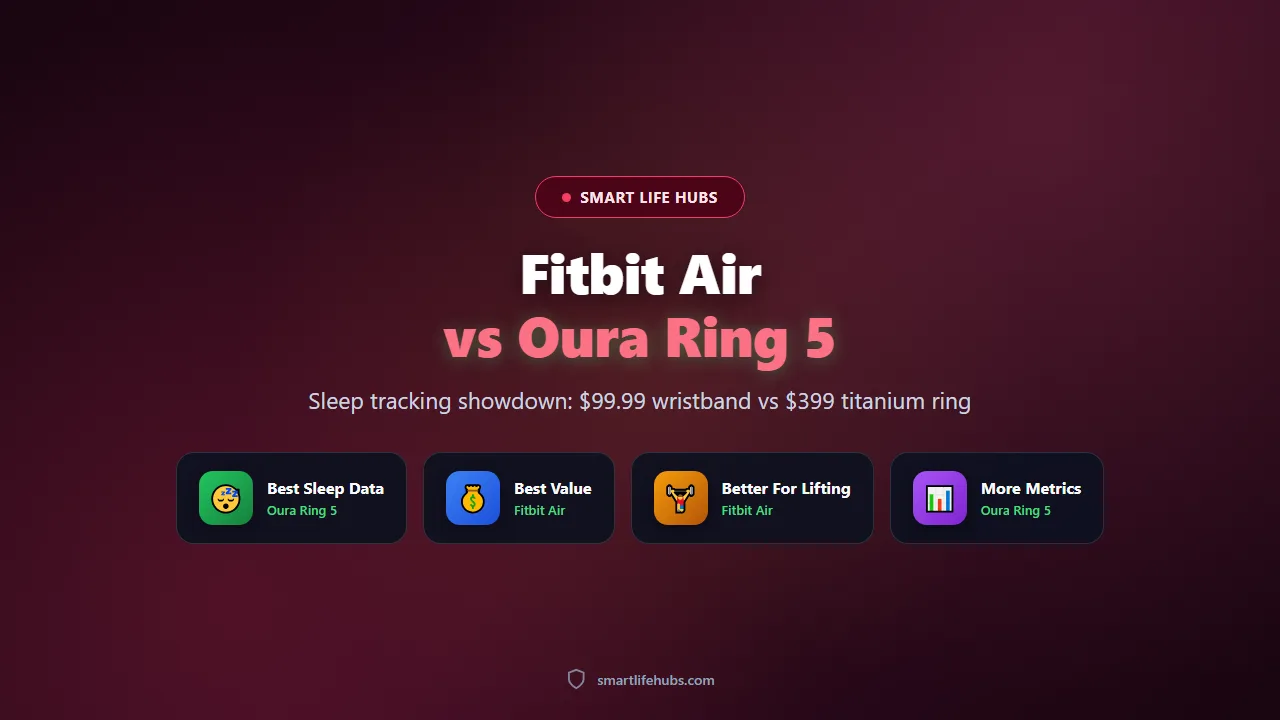
The Fitbit Air and the Oura Ring 5 are the two screenless trackers that show up in every sleep conversation, and they solve the same problem from different fingers. The Air is a 12 gram pebble in a fabric wristband for $99.99. The Ring 5 is a titanium band on your finger for $399, plus a $5.99 monthly membership if you want the full app. One is the best value in sleep tracking. The other is the reference standard. They are not really competing for the same buyer, and the right choice comes down to whether you want the best sleep data or the best deal.
Oura announced the Ring 5 on May 28, 2026 and put it on sale June 4. It is 40% smaller by volume than the Ring 4, at 6.09 millimetres wide and 2.28 millimetres thick, and it adds a Health Radar feature that reads blood pressure signals and nighttime breathing. The Air arrived three weeks earlier at a third of the price, and it made screenless tracking cheap enough to buy on impulse. Both are genuinely good. Only one of them is worth $399 to most people.
I compared manufacturer specifications, PCMag’s and Tom’s Guide’s published testing, Which?’s lab results for the Air, and long-term owner reports from Reddit and the Oura community. Where a figure is a claim rather than a measurement, I say so. Prices are US street prices as of November 2026, and the Ring 5 is frequently discounted by $100 during sales.
At a glance
| Criteria | Fitbit Air | Oura Ring 5 |
|---|---|---|
| Price | $99.99 once | $399 (Silver, Black) or $499 (premium finishes) |
| Subscription | Optional, $9.99 per month | Required for full insights, $5.99 per month or $69.99 per year |
| Form factor | Wrist pebble in fabric band | Titanium ring on finger |
| Weight | 5.2g capsule, 12g with band | 2 to 2.69g depending on size |
| Battery | 7 days claimed, 8.5 days tested | 6 to 9 days depending on ring size |
| Water resistance | 50 metres (5ATM) | 100 metres (IP68) |
| Sensors | Heart rate, SpO2, skin temperature, accelerometer, gyroscope | Multi-channel PPG, SpO2, temperature, accelerometer, Health Radar |
| Sleep tracking | Sleep stages, score, readiness, free in Google Health | Sleep stages, score, sleep debt, body clock, chronotype |
| Daytime and workouts | Steps, calories, cardio load, auto-detection | Activity goals, 40+ auto-detected activities, weaker in hard sessions |
| Built-in GPS | No, connected GPS only | No |
| Best for | First-time buyers and value hunters | People who want the deepest sleep data |
Fitbit Air vs Oura Ring 5: how they compare
Price and ownership
The Air is $99.99 and it works out of the box with no membership. The Ring 5 is $399 for the Silver or Black finish and $499 for Gold, Stealth, Brushed Silver, or Deep Rose, and the full app needs an Oura Membership at $5.99 a month or $69.99 a year. Over three years the Air costs $100, or about $459 if you keep Google Health Premium. The Ring 5 costs between $615 and $715 with the membership. Without the membership you still get the three daily scores, battery level, profile, settings, and Explore, but none of the trends that make the ring worth buying. This is the widest price gap in the screenless category, and it frames every other comparison here.
Sleep tracking
This is the reason to buy the Ring 5, and it delivers. Oura captures brief wake-ups that wrist trackers smooth over, gives you a sleep score with a breakdown of stages, and adds sleep debt tracking and a body clock feature that compares your chronotype against your actual bedtime. Owners consistently report that the ring matches their own sense of how they slept, and it is the closest thing the consumer market has to a reference standard. The Air is good rather than great. In one three-way test it recorded roughly 30 minutes more sleep than the ring and a Galaxy Watch Ultra 2, and its readiness scores ran lower than owners expected. The free Google Health app does give you real sleep stages, a score, resting heart rate, HRV, respiratory rate, and skin temperature, which is more than most $100 devices offer. The ring adds a body clock feature that estimates your optimal sleep window from your chronotype and then compares it against when you actually go to bed, which is the kind of nudge the Air simply does not have. If sleep is the only metric you care about, Oura wins. If you want solid sleep data and a hundred dollars left over, the Air is close enough that the gap is hard to justify at six times the cost. For the testing methods behind these numbers, our fitness tracker accuracy guide explains how wearable sensors are measured.
Comfort and 24-hour wear
The Ring 5 is 2 to 2.69 grams and 2.28 millimetres thick, and most owners forget it is on. The Air is 12 grams with the band, which is also light enough to ignore during sleep. The difference shows up in the day. A ring comes off for heavy lifting, grappling, climbing, and any sport where a metal band on a gripping finger is a hazard or a distraction. A fabric wristband stays put through a squat session and never gets in the way of a barbell. If your training is strength-heavy, the Air is the more practical device. If you run, swim, or do yoga and want the least obtrusive sensor possible, the ring wins. Both are rated for swimming, with the ring’s 100 metre rating ahead of the Air’s 50 metres.
Daytime tracking, workouts, and recovery
The Air is the better daytime fitness tracker. It counts steps, estimates calories, tracks Active Zone Minutes, and reports Cardio Load and a Daily Readiness Score, all free. Its automatic workout detection is inconsistent but usable, and it logs walks, runs, rides, and gym sessions without much input from you. The Ring 5 auto-detects more than 40 activities and sets dynamic goals, but reviewers describe its exercise tracking as trend-based rather than precise, and it struggles in hard intervals where wrist-based optical sensors usually do better. Neither has built-in GPS, so both need your phone for mapped routes. For recovery, the Air gives you a readiness number and a caffeine window with Premium, while the ring gives you Readiness, resilience, cardiovascular age, and metabolic health trends with the membership.
Sensors and health features
The Ring 5 carries two triple LEDs covering red, green, and infrared, two photodetectors, a digital temperature sensor, and an accelerometer, with 12 signal pathways that Oura says improve accuracy across finger sizes and skin tones. Its headline new feature is Health Radar, which reads blood pressure signals and nighttime breathing patterns, and the app reports on more than 50 health metrics including cardiovascular age, cardio capacity, and metabolic health. The Air carries an optical heart rate monitor, a three-axis accelerometer, a gyroscope, red and infrared sensors for blood oxygen, and a skin temperature sensor, and it can flag signs of atrial fibrillation while you are still or asleep. Neither device has an ECG. Onboard storage favours the Air, which holds a week of motion detail and a day of workout metrics, while the ring holds three days.
Battery and charging
The Air runs 7 days by claim, 8.5 days in PCMag’s testing, and 199 hours in Which?’s lab, and a 5-minute charge returns about a day of use. The Ring 5 runs 6 to 9 days depending on ring size, because smaller rings carry smaller batteries, and a full charge takes about 80 minutes on the included dock. Oura sells a charging case for $99 that adds up to a month of battery and returns a full day in 10 minutes. Both are charge-weekly devices, and neither will strand you for long. If you travel a lot, the ring’s case is the more convenient accessory.
App and coaching
Oura’s app is friendlier and calmer, with line graphs that flag outliers instead of flooding you with charts. Google Health is more cluttered, and owners have reported bugs and sleep-tracking inconsistencies even after updates. The Air’s free tier is genuinely useful, showing stages, trends, and scores without a paywall, while the ring’s free tier is a demo. With Google Health Premium at $9.99 a month you get a Gemini-powered coach that answers questions about your data, builds fitness plans, and logs meals by photo or voice. With the Oura Membership you get the full sleep and readiness breakdown. Both paid tiers are good. Only one of them is optional.
Which one should you buy
Buy the Fitbit Air if you want the best value in sleep tracking. At $99.99 with no required subscription, it delivers real sleep stages, readiness, HRV, and SpO2 for a tenth of the cost of a premium ring. It suits first-time buyers, gym-goers, and anyone who does not want a recurring fee. Add Premium only if you find yourself asking the app for advice rather than numbers.
Buy the Oura Ring 5 if sleep is the metric you would pay to perfect. It captures wake-ups and sleep architecture more faithfully, and its app presents the data more clearly. It is the right choice if you manage your training load closely, work shifts, or simply care more about sleep than about steps. Accept the $399 hardware cost and the membership, because the ring without it is half a product.
Consider neither if you want GPS or a screen. Both rely on your phone for mapped workouts, and neither shows notifications. If you want a readable face and on-wrist navigation, an entry-level sports watch costs less than the Ring 5 and does more.
Think about your training before you choose a form factor. Rings and barbells do not mix well. If you lift heavy, climb, or grapple, a ring will spend training sessions in a pocket. The Air’s fabric band will not. For a direct head-to-head on sleep and stress, Tom’s Guide’s Fitbit Air vs Oura Ring 5 comparison covers the same ground. For a broader look at rings that skip the subscription, our no-subscription smart ring roundup is worth reading.
Check the sizing before you commit to a ring. The Ring 5 comes in US sizes 6 to 13, and Oura says sizing differs slightly from the Ring 4, so order the sizing kit and wear it for a day before choosing. A ring that is too loose rotates and corrupts the readings; too tight and it restricts blood flow, which also ruins the data. The Air’s band adjusts with a Velcro closure, so fit is rarely a problem.
Think about the exit cost before you start. The Air is a one-time purchase that keeps working with the free app no matter what. The Ring 5 is a $399 purchase plus a membership that unlocks the reason you bought it. If your budget is unpredictable, the Air’s worst case is $100. The ring’s worst case is a $399 paperweight with three scores on the screen.
Frequently asked questions
Frequently Asked Questions
6Which is better for sleep tracking, the Fitbit Air or the Oura Ring 5?
The Oura Ring 5. It captures brief wake-ups and sleep stages more faithfully, and its app presents sleep debt, body clock, and chronotype insights that the Air does not match. The Air is good for the price, but it recorded about 30 minutes more sleep than the ring in one three-way test, and its readiness scores ran lower than owners expected.
Do you need an Oura membership to use the Ring 5?
You need it for the useful features. Without a membership the app shows three daily scores, battery level, profile, settings, and Explore, but not the sleep trends, readiness breakdown, or long-term insights. Membership costs $5.99 a month or $69.99 a year, and new rings include one free month.
Can you lift weights with the Oura Ring 5?
It is not recommended for heavy lifting, climbing, or grappling. A metal ring on a gripping finger is a hazard with a barbell and a distraction with a pull-up bar. Oura says the ring is fine for everyday wear and swimming to 100 metres, but most owners take it off for strength sessions. If you lift, the Fitbit Air’s fabric band is the safer choice.
Is the Fitbit Air accurate for sleep?
Reasonably, though not at Oura’s level. The free Google Health app gives you sleep stages, a sleep score, resting heart rate, HRV, and respiratory rate, and independent reviewers describe the data as solid. Owner reports flag occasional inconsistencies and bugs, and one test showed the Air recording more sleep than the ring. For the price it is one of the better sleep trackers you can buy.
Which lasts longer on a charge, the Fitbit Air or the Oura Ring 5?
They are close. The Air runs 7 days by claim and 8.5 days in testing, while the Ring 5 runs 6 to 9 days depending on ring size, with smaller rings carrying smaller batteries. Both are weekly-charge devices, and the Air’s 5-minute fast charge is the better safety net when you forget.
Does the Oura Ring 5 work with an iPhone?
Yes. The Ring 5 works with iOS 16 or later and Android 11 or later with Google Play services, over Bluetooth 5.0. It integrates with more than 100 health apps and writes to Apple Health. The Fitbit Air also works with both platforms and syncs exercise, sleep, steps, and vitals to Apple Health.
The bottom line
Buy the Fitbit Air if you want the best sleep tracker under $100: $99.99 once, 12 grams, real sleep stages and readiness free in Google Health, and a fabric band that survives lifting sessions. Buy the Oura Ring 5 if sleep is the number you would pay to perfect and you can accept $399 plus $69.99 a year for the membership that unlocks the full app. For most people the Air is the smarter purchase, and the $300 saved buys a better mattress than any ring will tell you how to use. If you want a ring but not the subscription, the no-subscription options in our roundup are worth a look. Which one would you wear to bed? Tell us in the comments.


Leave a Comment