
In this discussion, you can learn What are Kegel exercises? Kegel exercises also known as pelvic floor exercises are a series of exercises designed to strengthen the muscles of the pelvic floor.
Pregnancy, childbirth, obesity, aging, and certain medical diseases can weaken these muscles which support the bladder, rectum, and urethra.
What are Kegel Exercises?
The muscles supporting the rectum, uterus, and bladder are contracted and relaxed in Kegels which are a type of pelvic floor exercise.
Numerous advantages can result from performing these workouts such as enhanced sexual performance, decreased danger of pelvic organ prolapse, quicker recuperation following childbirth, and better bladder control.
Individuals of any age or gender can execute it because it is an easy task.
It’s important to use proper form, and speaking with a healthcare provider is advised to confirm the frequency and proper form of exercise.
Your pelvic floor can become healthier and your general quality of life can be enhanced by including it in your regular regimen.
It is named after Dr. Arnold Kegel, an American gynecologist who first described the exercises in the late 1940s as a way to help women with stress urinary incontinence.
Since then, Kegels have been recommended for both men and women to improve overall pelvic health and prevent or treat urinary incontinence, pelvic organ prolapse, and other pelvic floor disorders.
Kegel Exercises Benefits
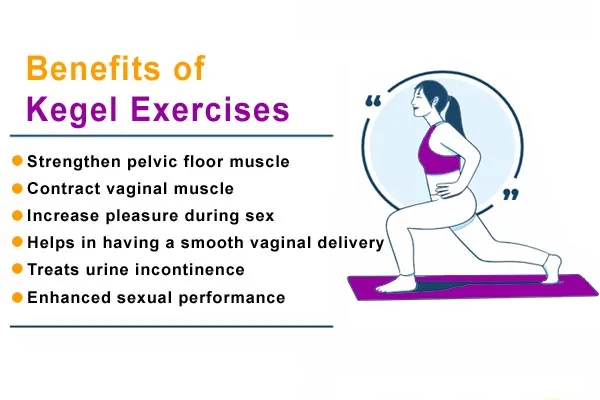
It has a lot of benefits like preventing pelvic organ prolapse, improving sexual function, recovering faster after giving birth, and improving bladder control.
These exercises are easy to do and can be performed by people of all ages and genders.
Proper technique is crucial, and it’s recommended to consult with a healthcare professional for guidance on form and frequency.
Incorporating it into your daily routine can improve pelvic floor health and enhance your overall quality of life.

Improved Bladder Control:
Kegels can improve bladder control and prevent or treat urinary incontinence.
Improved Sexual Function:
It can improve sexual function in both men and women by increasing blood flow to the pelvic region and improving muscle strength.
Reduced Risk of Pelvic Organ Prolapse:
It can help reduce the risk of pelvic organ prolapse, a condition where the pelvic organs descend into the vaginal canal.
Faster Recovery After Childbirth:
Kegels can help women recover more quickly after childbirth by improving pelvic muscle strength.
Improved Quality of Life:
These exercises can improve quality of life by reducing the frequency and severity of urinary incontinence, as well as improving sexual function and preventing prolapse.

How to Do Kegel Exercises?
Identify the Correct Muscles:
Choosing the appropriate muscles is the initial step in performing Kegels.
You utilize these muscles to hold back gas or to stop the flow of pee.
Try stopping the flow of pee when using the restroom to locate these muscles.
Your pelvic floor muscles are the ones you employ for this.
Reminder: Avoid performing it while urinating to prevent urinary tract infections.
Get in Position:
It can be done while seated, standing, or lying down.
Select a relaxed position where you may spread your body out comfortably.
Contract Your Pelvic Floor Muscles:
Squeeze your pelvic floor muscles upward and inward to contract them.
Think of lifting the muscles upward and inward toward your abdominal button.
During the workout be sure to maintain your thighs and buttocks relaxed.
Note: Breathing should not be held when performing Kegels.
Hold the Contraction:
Hold the contraction for 3-5 seconds, or as long as you can without straining.
Gradually work your way up to holding the contraction for 10 seconds.
Release the Contraction:
Spend the same amount of time relaxing your muscles as you did letting the contraction out gradually.
Aim to perform at least three sessions every day, repeating the exercise 10–15 times each.
Note: Don’t perform too many Kegels.
Overtraining can cause soreness and muscle aches.
Variations of Kegel Exercises:
After you have mastered the fundamental Kegels you can experiment with different versions to spice up and diversify your regimen.
You can try a few of the following variations:
Rapid Contractions: Contract and release your pelvic floor muscles as quickly as possible for 10 seconds.
Super Kegels: Hold a contraction for as long as you can, up to 30 seconds.
Bridge Kegels: Perform a kegel while simultaneously lifting your hips off the ground.
Squat Kegels: Perform a kegel while in a squatting position.
Side-to-Side Kegels: Perform a Kegel while simultaneously contracting one side of your pelvic floor muscles, and then the other.
Kegel exercises are a simple and practical approach to enhancing pelvic floor health in addition to these advantages. They may also be performed in practically any place.
People of various ages and genders can benefit from them as well.
It’s crucial to keep in mind that it might not be suitable for everyone, particularly if you have a medical condition or are recovering from surgery.
For advice on appropriate technique and exercise frequency, it is best to speak with a healthcare practitioner before deciding whether it is right for you.






Leave a Comment