
A grip strengthener is a small spring-loaded tool you squeeze, and it trains the muscles of the forearm and hand that most gym programmes ignore. The category has two designs: fixed grippers calibrated to a known resistance, and adjustable grippers that change with a dial or a screw. Fixed grippers are more precise and more expensive over time; adjustable ones are cheaper to start and cover a range with one tool.
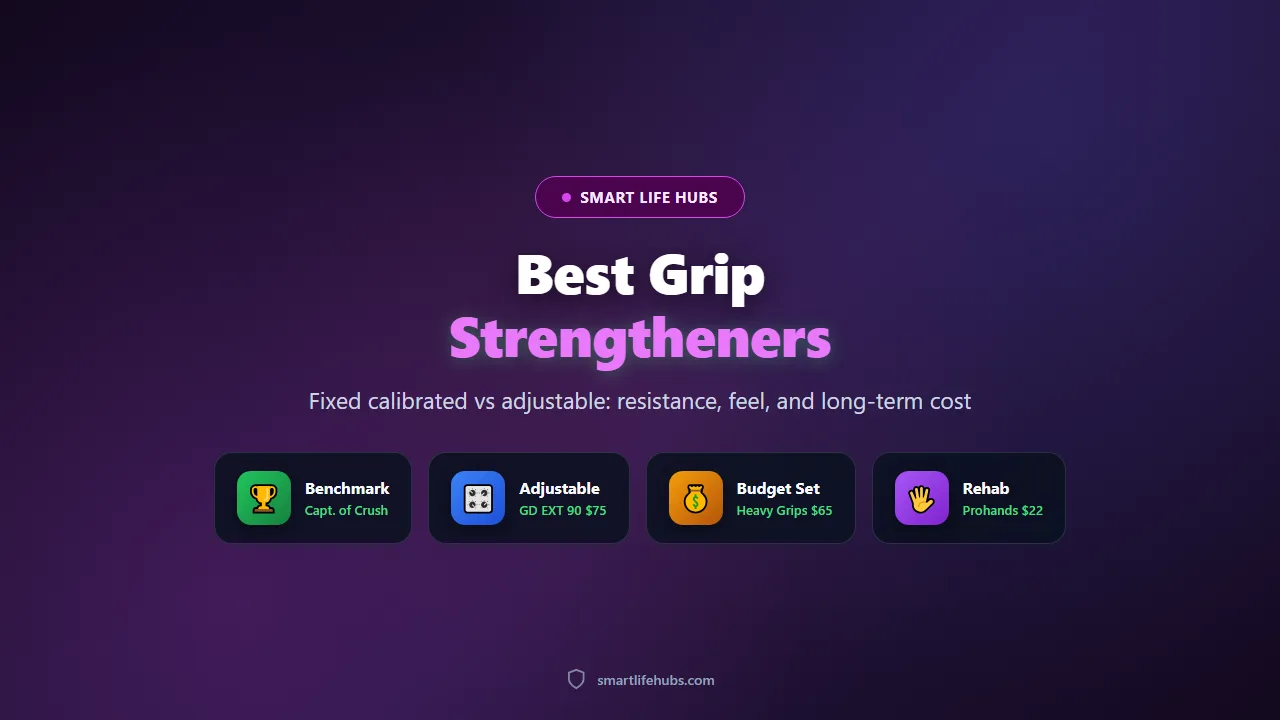
Prices run from about $10 for a budget adjustable gripper to about $110 for a calibrated set. The IronMind Captains of Crush set at about $111 is the benchmark serious lifters use, the GD Iron Grip at about $70 to $75 is the best adjustable option, the Heavy Grips six-pack at about $65 is the best budget set, and the FitBeast at about $10 is the cheapest way to start.
I pulled Home Gym Verdict’s ranked grip strengthener guide, Legion Athletics’ in-depth comparison, RepReturn’s four-tool test, Home Court Athlete’s 2026 home gym picks and BestExercise’s UK guide. Where a figure is a claim rather than a measurement, I say so. Prices are US street prices as of November 2026.
At a glance
| Product | Best for | Key specs | Price |
|---|---|---|---|
| Captains of Crush (set of 3) | Best overall | Fixed calibrated springs, 80 to 365 lb full line, knurled aluminium handles | About $111 a set |
| GD Iron Grip EXT 90 | Best adjustable | Screw-adjustable about 55 to 198 lb, carbon steel and aluminium, silent | About $70 to $75 |
| Heavy Grips 6-Pack | Best budget set | Fixed calibrated 100 to 350 lb, six grippers | About $65 |
| Prohands Gripmaster | Best for rehab | Finger isolation pistons, 1 to 9 lb per finger | About $22 |
| FitBeast Adjustable | Best value | Adjustable 10 to 132 lb, single gripper, compact | About $10 |
The best grip strengtheners of 2026
1. Captains of Crush, best overall
The IronMind Captains of Crush grippers are the reference standard in grip training, and a set of three covering the Trainer, No. 1 and No. 2 costs about $111. They are fixed, calibrated springs with knurled aluminium handles, running from 80 pounds on the Trainer to 365 pounds at the top of the full line, and RepReturn calls them the grippers competitive grip athletes actually use and benchmark against. Home Gym Verdict names the set the best overall for calibrated, USA-made progress.
The trade-offs are the cost and the jumps between levels. Because each gripper is fixed, progressing means buying another one, and the steps between levels are large, so the Trainer and No. 1 are already tough for most people. Start lighter than your ego suggests.
- Pros: About $111 a set; calibrated and consistent; the recognised benchmark; durable aluminium
- Cons: Fixed resistance, so you buy more to progress; large jumps; expensive long term
Check today’s price on Amazon.
2. GD Iron Grip EXT 90, best adjustable
The GD Iron Grip EXT 90 costs about $70 to $75 and it is the tool for someone who wants one gripper that covers years of progress. It adjusts across roughly 55 to 198 pounds with a screw mechanism, the handle width adjusts between a 4 inch basic setting and a narrower 3 inch setting, and the build is carbon steel and aluminium. RepReturn calls it the best adjustable for advanced users, noting that most adjustable trainers top out well below what a strong lifter needs while most tools that reach high resistance are fixed.
The trade-offs are the price and the fact that it is a specialist purchase. At about $77 it costs more than a set of budget fixed grippers, and Legion Athletics notes it makes sense mainly for someone who has outgrown a cheap adjustable set and wants fine increments rather than jumps.
- Pros: About $70 to $75; 55 to 198 lb in one tool; adjustable handle width; near-silent
- Cons: Expensive; screw adjustment is slower than a fixed gripper; specialist
Check today’s price on Amazon.
3. Heavy Grips 6-Pack, best budget set
The Heavy Grips six-pack costs about $65 and it gives you the calibrated progression concept for less than the Captains of Crush. The set covers roughly 100 to 350 pounds across six fixed grippers, so you get known increments to progress through without paying IronMind prices, and Home Gym Verdict recommends it for budget-conscious buyers who want the same idea at a lower cost.
The trade-offs are the build quality and the calibration confidence. Legion Athletics warns that some cheaper fixed grippers are suspiciously light and may not match their stated resistance, so treat the numbers as approximate rather than a competition standard.
- Pros: About $65 for six; 100 to 350 lb; calibrated progression; cheaper than CoC
- Cons: Build quality varies; resistance may not match the label; no fine adjustment
Check today’s price on Amazon.
4. Prohands Gripmaster, best for rehab
The Prohands Gripmaster costs about $22 and it is a different tool from the others: each finger has its own piston with a resistance of 1 to 9 pounds, so you train the individual fingers rather than the whole hand at once. Home Gym Verdict names it the best for rehab and dexterity, and this is the design physical therapists use for hand and finger injuries.
The trade-offs are that it does not build the crushing grip strength that a heavy gripper does, and the light resistances will not challenge a strong lifter. It is a precision tool for hand health rather than a strength tool.
- Pros: About $22; 1 to 9 lb per finger; finger isolation; rehab standard
- Cons: Light resistance; not for building crushing strength; plastic build
Check today’s price on Amazon.
5. FitBeast Adjustable, best value
The FitBeast Adjustable Grip Strengthener costs about $10 and it is the cheapest serious way to find out whether you will use a grip trainer. It is a single adjustable gripper covering roughly 10 to 132 pounds, it is small enough to keep on a desk, and RepReturn calls it the lowest-risk way in because it removes every excuse not to start.
The trade-offs are the ceiling and the build. Legion Athletics warns that a $10 gripper may squeak, may not deliver its advertised resistance and will not last years, so treat it as a starter rather than a long-term tool.
- Pros: About $10; adjustable 10 to 132 lb; compact; cheapest entry
- Cons: Lower resistance ceiling; may not match the label; shorter life
Check today’s price on Amazon.
A simple grip routine
The basic routine is a full close and a hold. Set the gripper to a resistance you can close for about 10 to 15 reps, do three sets with a minute between them, and finish each set with a 10 second hold at the closed position. That combination builds both the explosive close and the support strength that matters for holding a bar.
The second option is negatives and partials. If a gripper is too hard to close from the start, begin with a assisted close using your other hand, then resist the opening for a few seconds. This lets you train at a level above your current max and is the standard way grip athletes progress.
The third is the rolling grip, which no spring gripper trains. Carrying heavy dumbbells or hanging from a bar builds the support grip that a crusher alone will not touch, and most people need both.
Progress by moving up a level only when you can complete your sets with clean form, and keep a note of which level you are on. Grip strength moves slowly, so a record is what tells you the training is working.
Finally, rest the forearms when they are sore. Grip training uses the same muscles as pulling, so a heavy deadlift session and a hard grip session in the same week is often too much for a beginner.
Living with a grip strengthener
The first thing you learn is that grip training is boring and easy to skip, which is why a desk gripper wins. Five minutes of squeezes during a call adds up over a month, and the $10 FitBeast is the tool for that. A calibrated gripper needs a session and a log, which suits a different temperament.
The second is that the forearms adapt quickly and then plateau. Because grip is used in every pulling exercise, adding direct grip work can interfere with your lifting if you overdo it, so start with two or three sets a week rather than daily.
The third is that the numbers matter differently depending on the tool. A Captains of Crush level is a recognised benchmark you can compare with others, while an adjustable gripper’s dial is only useful for tracking your own progress. Do not compare the two as if they were the same scale.
The fourth is hand health. Grip training can aggravate elbow tendons and existing finger injuries, so if you have a history of tennis elbow or a finger problem, use a finger-isolation tool like the Prohands and build up slowly.
The fifth is that grip strength has a ceiling set by your wrist and forearm structure, so progress is slow and the early gains are the largest. Expect a few months to move up a level rather than a few weeks.
The short version is that a gripper you keep on the desk beats a calibrated set you have to plan a session around.
How to choose a grip strengthener
Decide fixed or adjustable. A fixed calibrated gripper gives you a known resistance and a benchmark, and costs more as you progress. An adjustable gripper covers a range with one tool and is cheaper to start. If you want to track progress against a standard, go fixed.
Start lighter than you think. The levels jump steeply, and the Captains of Crush Trainer at 80 pounds is already tough for most people. Buying a gripper you cannot close is the most common beginner mistake.
Check the handle and the spread. Handle width changes how a gripper feels, and the GD’s adjustable spread is a real advantage for smaller or larger hands. A gripper that does not fit your hand will feel harder than it is.
Think about noise. A cheap gripper squeaks, which matters if you use it at a desk or in a quiet house. RepReturn notes the GD is near-silent, and Legion Athletics warns cheap models often squeak.
Match it to your goal. For crushing strength and pulling performance, a heavy fixed or adjustable gripper. For finger dexterity, rehab or a desk habit, a light finger-isolation tool. They are different jobs.
Check the resistance claims. Calibrated brands publish verified levels, while some budget grippers understate or overstate theirs. If the number matters, buy a brand that calibrates.
Do not overbuy. The category works from about $10 to $110, and consistency matters more than the tool. A $10 gripper used daily beats a calibrated set used twice.
Think about the rest of the kit. Our stretching strap guide covers the mobility side of hand and forearm health, and our fitness tracker roundup covers the lifting that grip supports.
Frequently asked questions
Frequently Asked Questions
6What is the best grip strengthener?
The IronMind Captains of Crush set of three at about $111 for serious progress, because the calibrated levels are the recognised benchmark. The GD Iron Grip at about $70 to $75 if you want one adjustable tool, and the FitBeast at about $10 if you are testing the idea.
Are Captains of Crush worth the money?
If you want measurable, comparable progress and a tool that lasts, yes, because the levels are calibrated and the aluminium handles are durable. If you just want to squeeze something at your desk, a $10 adjustable gripper does most of the job.
How often should I train grip?
Two or three sessions a week is enough for most people, because the forearms are used in every pulling exercise and adapt quickly. More than that can aggravate elbow tendons.
Can a grip strengthener help with climbing or lifting?
Yes, for the crushing and support grip used in pulling and holding. It will not replace the specific grip positions a climber needs, and it should be added to rather than substituted for pulling work.
What resistance should a beginner start with?
Lighter than you expect. The Captains of Crush Trainer at 80 pounds is already challenging for most people, so a beginner should look at the lighter levels or a low setting on an adjustable gripper.
Are cheap hand grippers accurate?
Not always. Legion Athletics warns that some budget grippers are suspiciously light and may deliver less resistance than advertised, so treat the dial as a guide to your own progress rather than an absolute number.
The bottom line
Buy the Captains of Crush set of three if you want the recognised benchmark and calibrated progress: about $111, fixed springs from 80 to 365 pounds and aluminium handles. Buy the GD Iron Grip EXT 90 at about $70 to $75 if you want one adjustable tool covering about 55 to 198 pounds. Buy the Heavy Grips six-pack at about $65 for the calibrated idea on a budget, the Prohands Gripmaster at about $22 for finger rehab, and the FitBeast at about $10 for the cheapest way to start. Home Gym Verdict’s ranked grip strengthener guide reached the same conclusion on the Captains of Crush as the best overall. The honest summary is that the calibrated fixed gripper is the better tool for serious progress, the adjustable gripper is the better value for most people, and the $10 desk gripper is the one you will actually use. How often will you really train it? Tell us in the comments.

Leave a Comment